TLDR. An NCA reaches a segmentation by iterating a local update rule, so we probe how stable that final state is: resilience perturbs it with small noise and checks whether the prediction snaps back. Stable predictions are confident; predictions that drift are flagged as uncertain. No retraining is required.
Neural cellular automata (NCA) provide a lightweight alternative to encoder–decoder segmentation networks. However, it can be difficult to decide when a prediction should be trusted. Here, we study uncertainty estimation for NCA-based medical image segmentation without modifying the underlying architecture or retraining the model. Our approach is motivated by viewing the NCA as a dynamical system where convergent attractors correspond to confident predictions. Concretely, we propose resilience, a simple measure that leverages the intrinsic iterative structure of NCAs by probing the stability of the final prediction under small perturbations of the automaton state. Predictions that return to the same solution are deemed confident, while those that change substantially are flagged as uncertain. We evaluate uncertainty by its ability to predict segmentation quality using selective prediction metrics (ΔDice@90 and AURC) and ranking metrics (AUROC and AUPRC). Across multiple medical segmentation benchmarks, resilience identifies failure cases more reliably than baselines, improving trust and safety in NCA-based models.
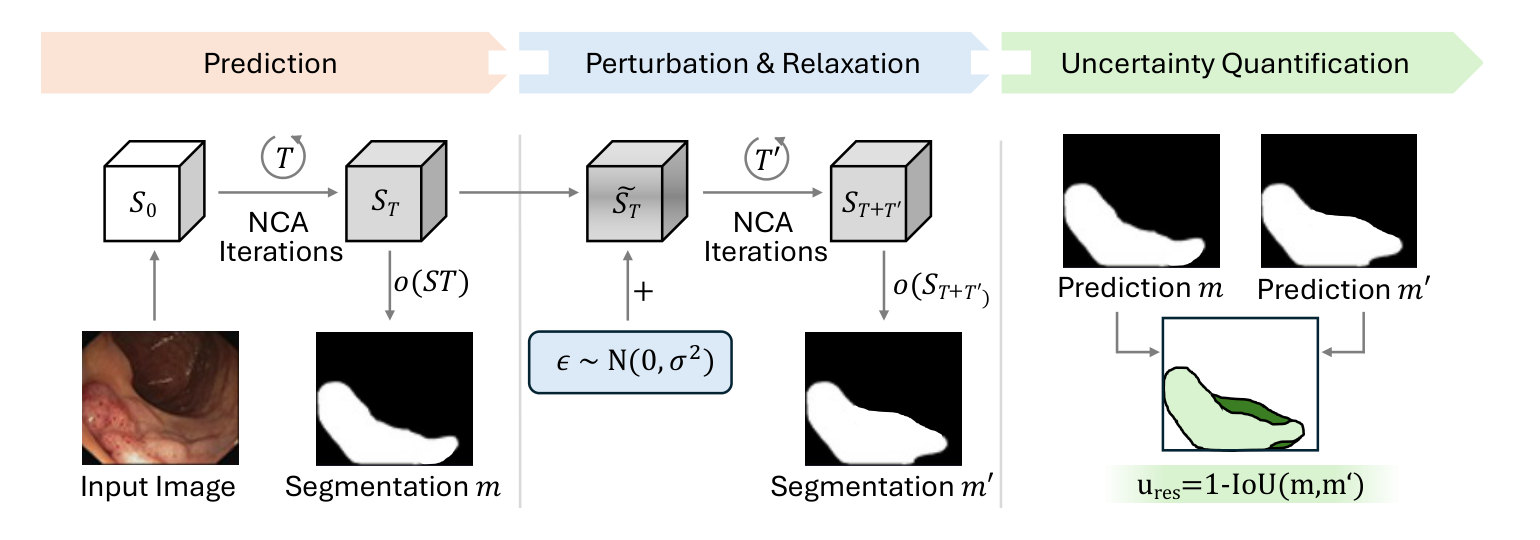
Unlike Monte Carlo dropout, which needs stochastic subnetworks built into the architecture, resilience tests the stability of an already-trained model directly, with no retraining, no architecture changes, and just one extra rollout per image. We compare it against five rollout-derived baselines: single-pass entropy, stopping-time disagreement, late-stage drift, binary flicker, and test-time augmentation (TTA).
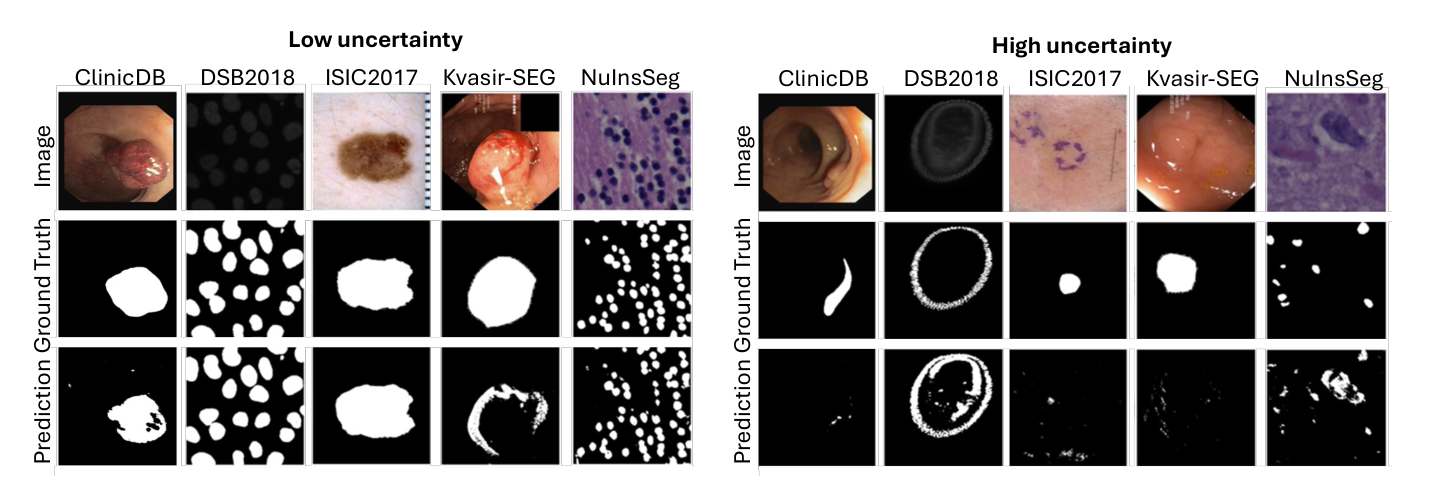
We evaluate on five medical segmentation benchmarks (ClinicDB, Kvasir-SEG, DSB 2018, ISIC 2017, and NuInsSeg) spanning colonoscopy, microscopy, dermoscopy, and histology, with Dice scores ranging from 0.60 to 0.94 depending on task difficulty.
Resilience gives the most consistent uncertainty signal of all methods tested: it improves selective prediction (ΔDice@90) on every dataset, from +4.06 points on the easy DSB 2018 up to +9.26 on Kvasir-SEG, while several baselines actually hurt selective prediction on harder datasets (e.g. negative ΔDice@90 for stability and stoptime on ClinicDB). It's also the strongest failure detector overall. The rare exceptions (stoptime on DSB 2018, TTA's AURC on Kvasir-SEG, flicker on NuInsSeg) don't transfer across datasets, whereas resilience does.
@inproceedings{sadafi2026resilience,
title={Measuring Prediction Uncertainty in Neural Cellular Automata},
author={Sadafi, Ario and Deutges, Michael and Navab, Nassir and Marr, Carsten},
booktitle={29th International Conference on Medical Image Computing and Computer-Assisted Intervention (MICCAI)},
year={2026},
note={arXiv:2605.26726},
url={https://arxiv.org/abs/2605.26726},
}